
If you have ever raised a snag with a developer, you will almost certainly have heard the phrase "that's within tolerance". And if you have raised quite a few, you may also have heard the reverse, where something is plainly out of tolerance but the developer is still reluctant to put it right.
Both situations leave new build buyers in the same place, which is wondering what "tolerance" actually means, who decides what is acceptable, and whether they simply have to live with it.
At Brickkickers, we have been carrying out independent snagging inspections across the UK since 2004, so we have spent two decades in the middle of this exact conversation. This post sets out what tolerance really means, the standards developers measure against, when out of tolerance leads to a fix and when it does not, and the practical steps you can take if you are not convinced by the answer you are getting.
Why new build homes are never perfect
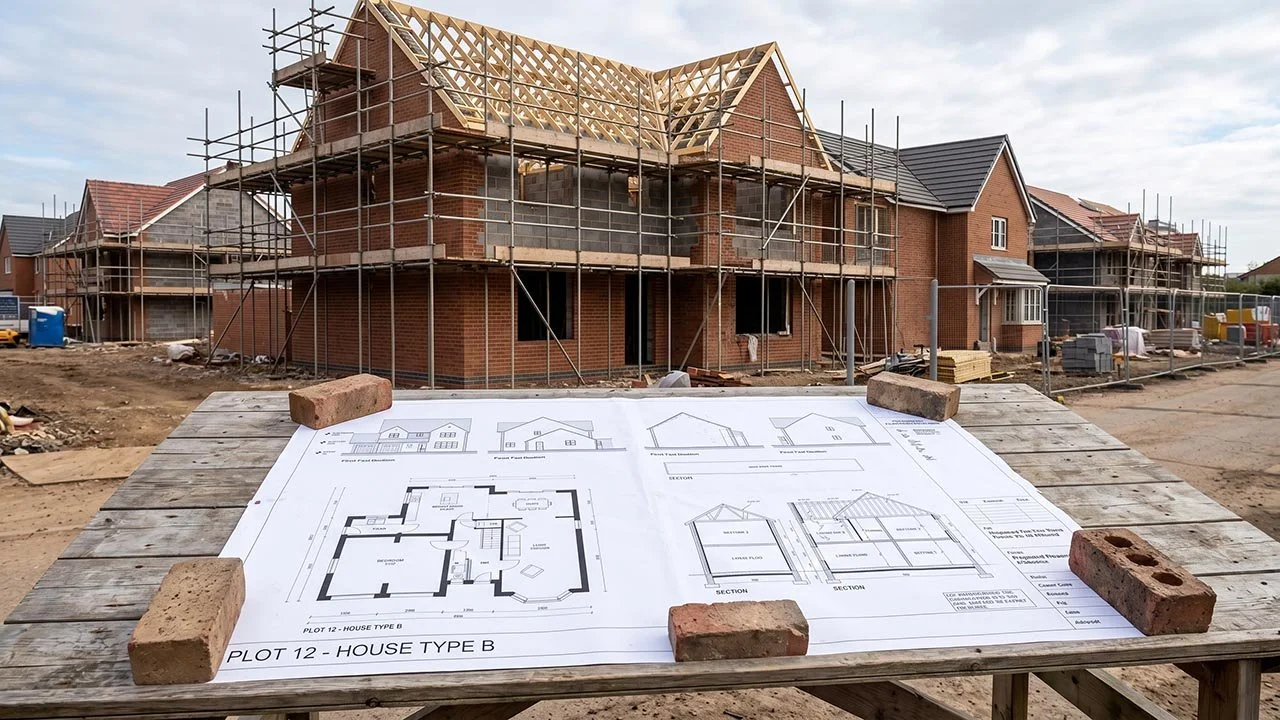
It helps to start with a reality check. A new build home is not a precision-manufactured product like a car or a washing machine. It is assembled on site, in the open air, by dozens of different trades, over many months, in whatever weather the British climate throws at it. Bricks are laid by hand. Plaster dries unevenly. Timber moves as it acclimatises. Concrete shrinks as it cures.
The Home Builders Federation's 2025 National New Homes Customer Satisfaction Survey, based on 39,000 responses, found that 94% of buyers would recommend their builder to a friend and 86% were satisfied with the standard of finish. Those are reassuring headline numbers, but the same data confirms that snags are the norm rather than the exception. The HBF itself acknowledges that new homes are carefully constructed but snags can still occur because they are, in its words, a hand-crafted product. Separate analysis of the 2025 survey by HomeOwners Alliance noted that 93.7% of new build buyers reported problems to their builder, with more than a quarter reporting more than 15 snags. Professional snagging inspections often pick up many more items than the homeowner has noticed alone.
That is why the industry uses the concept of tolerance. Tolerance is the accepted level of variation between the ideal and what was actually built. It defines how far something can deviate before it stops being acceptable workmanship and becomes a defect that needs putting right.
What standards are tolerances actually measured against?
When a site manager says something is within tolerance, they are usually referring to one of four sources.
The first, and the one most often quoted in the UK, is the NHBC Standards, which applies to every new home registered with NHBC, sets out the technical requirements that builders must meet. Chapter 9.1, titled "A Consistent Approach to Finishes", is the chapter most relevant to homeowners because it covers the visible finishing tolerances on walls, ceilings, floors, doors, windows, tiling, joinery, glazing and decoration.
The second source is British Standards. BS 5606:2022, "Accuracy and tolerance in design and construction. Guide", is the umbrella reference for dimensional accuracy. The BS 8000 series, including BS 8000-0:2014 on general principles and BS 8000-3:2020 on masonry, covers workmanship on construction sites, with separate parts for plasterboard partitions and dry linings, glazing, carpentry and joinery, tiling, screeds, plastering and rendering, and painting. Builders are expected to work to these where relevant.
The third source is the warranty provider's own technical manual. NHBC's Buildmark is by some distance the largest, and NHBC's own estimate is that Buildmark covers approximately 80% of new homes built each year in the UK. LABC Warranty, Premier Guarantee, Advantage Home Construction Insurance and Build-Zone all publish their own technical standards. The principles are broadly similar but the wording, and occasionally the figures, can differ.
The fourth source is manufacturer recommendations. Doors, windows, kitchens, sanitaryware, boilers, flooring, tiles and roof tiles all come with specific installation instructions that the installer is required to follow. If they have not, the manufacturer's own guidance becomes the benchmark, not the more generic NHBC figure.
You are entirely within your rights to ask which of these the developer is relying on when they say something is acceptable. A straightforward question along the lines of "Which standard are you measuring this against, and what does it say?" is reasonable and should produce a clear answer.
What does "within tolerance" actually look like in numbers?
Knowing the numbers helps you have a more informed conversation. Drawing from NHBC's Chapter 9.1, some of the key permissible deviations for typical finishes include the following.
Internal walls may be up to 8mm out of plumb over a height of 2.5m, with external corners up to 10mm out of square when checked with a 500mm set square. Plastered surfaces should be flat to within 3mm under a 2m straight edge, and ceilings should be level within 3mm per metre over spans up to 6m, with deviation of up to 5mm under a 2m straight edge. Floors are allowed up to 4mm of deviation per metre over spans up to 6m, which in a 6m room can add up to a total of 24mm out of level across the room. Brickwork can be up to plus or minus 8mm out of plumb in 2.5m, and up to plus or minus 8mm out of line in any 5m section. Window cills can be 3mm out of level, with reveals 4mm out of line in any 1000mm. Doors are permitted to be 8mm out of plumb, and a door itself may be warped or twisted by up to 5mm in width or 9mm in height. Hairline shrinkage cracks up to 2mm are considered normal, rising to 4mm at staircase strings. Wall and floor tile joints should be straight and in alignment, with reasonably consistent grout widths, unless the tile pattern is irregular by design.
Inspection conditions matter just as much as the figures. Internal walls and ceilings should be viewed in natural daylight from a minimum of two metres, without a torch or low-angle light shone across the surface. Cupboards, wardrobes and fitted furniture are checked from half a metre. Glazing is viewed from two metres, and minor scratching within 6mm of the frame is treated as acceptable. The same inspection conditions are now baked into the New Homes Quality Board's standard Pre-Completion Inspection Checklist, which any suitably qualified inspector is required to use.
These figures are not unreasonable when you understand the construction process, but they do explain why a wall that looks slightly off, or a floor that feels mildly sloped underfoot, may still be reported back to you as "within tolerance".
When out of tolerance does, and does not, mean a rebuild
Here is the part that catches many buyers out. Being out of tolerance does not automatically mean something will be ripped out and rebuilt. Developers, and indeed warranty providers, make a judgement based on several practical factors: how noticeable the issue is in normal use, whether it actually affects how you live in the home, how significant the deviation is, and how disruptive the remedy would be.
In practice, certain types of out of tolerance issue are almost always resolved. Anything affecting how something functions, a door that catches on the frame, a window that will not seal properly, a kitchen unit that is misaligned so a drawer fouls, a tap that drips, a radiator that does not heat evenly, is the developer's responsibility and should be put right. Defects that are clearly visible at normal viewing distance, such as cracked tiles, conspicuous paintwork runs, badly mitred skirting, gaps around switch plates or chips in worktops, are also routinely fixed. So too are issues that can be remedied without major upheaval, like resealing a bath, re-hanging a misaligned door or replacing damaged ironmongery.
The harder cases are those where a measurement says one thing and common sense says another. Take a wall that is technically out of plumb. If the deviation is small, the wall is not unsafe, the lean is not visible to the eye, and it does not affect how kitchens or wardrobes fit against it, the likelihood of that wall being knocked down and rebuilt is extremely low. The remedy would involve scaffolding, stripping plaster, removing skirting and possibly flooring, rebuilding the wall, re-plastering, redecorating, and weeks of disruption, all for an issue you would never notice without a spirit level. NHBC's own guidance acknowledges this when it says the work needed to remedy minor variations from the tolerances should be proportionate and appropriate to the circumstances.
This is where snagger and builder can both, in their own way, be right. A good independent inspector will record what they find honestly, including items that are technically outside published tolerances. The builder may agree the measurement but argue that the remedy would cause more disruption than the defect warrants. Neither is necessarily lying. They are weighing the same facts on different scales.
It is also worth saying clearly that out of tolerance does not necessarily mean unsafe. Tolerance is about build quality and acceptable variation in finish, not about whether the home is sound. The two questions are different and should not be confused.
When out of tolerance is a sign of something more serious
There are, however, signs that an out of tolerance issue may be more than cosmetic and deserves further attention. These include movement or change over time, cracking that continues to widen after the first six to nine months, elements that stop functioning properly, doors or windows that worsen rather than settle, anything significantly out compared with the rest of the property, or unusual patterns such as diagonal cracks at the corners of openings.
If any of these apply, push harder. Ask for the developer's load-bearing or warranty inspector to attend rather than just the site team. NHBC operates a Resolution Service during the first two years of a Buildmark policy, where it will assess whether the builder has failed to meet its Technical Requirements and, if so, require the work to be done or pay for it to be completed by another builder. LABC Warranty, Premier Guarantee, Advantage and Build-Zone all operate broadly equivalent resolution arrangements within their builder warranty periods.
How to raise issues clearly, and what to do if you are not satisfied
How you raise a snag matters as much as what you raise. A factual, dated, photographed record carries far more weight than an emotive complaint. For each item, note the location, the issue, the measurement if relevant, the date you first noticed it, the date you reported it, and the developer's response. Keep everything in writing, ideally through the developer's online portal so there is a timestamped record.
If the developer's answer is "within tolerance" and you are not convinced, you have several practical options. The first is to ask, politely and in writing, exactly which standard the assessment is based on, what the measurement was, and where in that standard the figure sits. A reasonable developer will provide this. Second, keep clear records of everything, including photos, descriptions and written responses. Third, consider getting independent advice from a chartered building surveyor or an engineer if the item is more serious than cosmetic. Fourth, speak to your warranty provider, because they have their own technical standards and dispute resolution processes that sit alongside the developer's complaints procedure. Finally, assess the real-world impact honestly. Some battles are worth fighting and some are not.
If the developer is registered with the New Homes Quality Board, which according to the NHQB's Impact Report now covers more than 54% of new homes built across England, Scotland and Wales, the New Homes Quality Code sets a clear complaints timetable. You should receive a written acknowledgement within five calendar days of raising a complaint, a "path to resolution" letter within 10, and a full complaint assessment and response within 30. If the matter is not resolved within 56 days, you can refer it to the New Homes Ombudsman Service, which is free for consumers. The Ombudsman can require apologies, completion of outstanding work, and financial payments for distress and inconvenience up to a maximum of £75,000. In the NHOS Annual Report 2023/24, 8 of the 13 final decisions issued during the year were upheld in full or in part, with compensation payments ranging from £200 to £3,661 across the cases reported.
It is worth noting that sometimes compensation is offered as part of a resolution, but it is not guaranteed and it is not a substitute for fixing the defect itself.
What to focus on, and what to let go
When you walk around your new home with a snagging report in hand, the items most worth pushing for are visible defects you can see at normal viewing distance, anything that affects usability and function, and inconsistencies of finish that stand out against the rest of the property. Where a developer pushes back on minor cosmetic items that genuinely sit within the published tolerances, there is often little point in escalating, even if you find the result disappointing.
Tolerance is not about perfection. It is about what the industry has agreed is acceptable. But "acceptable" is not the same word as "good", and it does not oblige you to be happy with the outcome. Your strongest position is to know the standards, document everything carefully, focus on the items that genuinely matter, and use the dispute routes properly when you need to.
How Brickkickers can help
Twenty-plus years of independent snagging inspections have taught us that the buyers who get the best outcomes are not the ones who shout the loudest, but the ones whose evidence is the clearest. That is what we provide.
Our Standard Snagging Inspection is carried out after you move in and at any point during the first two years of your warranty, when the developer remains responsible for putting things right. Our Pre-Completion Inspection (PCI) is carried out before legal completion and aligns with the New Homes Quality Board's checklist, giving you the strongest possible position before you take ownership of the home. Every standard inspection includes Thermal Imaging as standard, which often picks up missing insulation, cold bridging and air leakage that the eye alone cannot detect. And where a dispute has become complex, our Customised and Intrusive Building Surveys provide the deeper evidence sometimes needed to resolve it.
If you are wondering whether something in your new home is truly within tolerance, or you simply want an experienced, independent set of eyes to tell you what is acceptable and what is not, we are happy to help.
Call us on 0845 226 6036, email info@brickkickers.co.uk, or book your inspection.