
What Lies Beneath: Understanding Floor Standards in Your New Build Home
When you step into your new build home for the first time, the floors beneath your feet might not be the first thing you examine closely. Yet floor finishes represent one of the most common areas where defects occur in new construction, and problems here can lead to significant issues down the line.
From cracked tiles to squeaky floorboards, understanding what constitutes proper floor installation can help you identify issues before they become costly problems.
At Brickkickers, our inspectors regularly find floor-related defects during snagging inspections. This guide will walk you through the key aspects of floor finishes in new build homes, explaining what standards builders should meet and what you should look out for when examining your new property.
The Foundation: Understanding Screeds
Before any visible floor finish is applied, most new build homes require a screed layer. This cement-based material sits on top of the concrete base and provides a smooth, level surface for your final floor covering. Getting this foundation right is crucial, as problems with the screed can manifest in the floor finish above.
For a screed to perform correctly, the surface beneath it must be properly prepared. Builders should ensure the background surface is clean and free of debris, with dust and gypsum removed. Concrete surfaces should be wetted and brushed before screeding begins. Where bonded screeds are required, cement grouting or a bonding agent should be specified to provide adequate adhesion. Damp proofing must also be completed before any screeding work starts.
The thickness of the screed matters considerably and depends on how it's being installed. When laid monolithically with the base (meaning installed within three hours of the concrete being poured), a minimum thickness of 12mm at any point is required. For screeds installed on a set and hardened base with bonding, this increases to 25mm. Where a separating membrane such as polyethylene is used, the minimum thickness rises to 50mm. For screeds installed on resilient slabs or quilts, which require wire mesh reinforcement, the minimum is 65mm.
Weather conditions play an important role in screed installation. Screeding should not take place during weather that could adversely affect the finished construction. In hot or dry conditions, precautions must be taken to prevent the screed surface drying out too quickly. In cold weather, screeds should not be installed at all, and any screed damaged by cold should be removed and replaced entirely.
If your new home has underfloor heating, the screed should be subdivided into bays not exceeding 40 square metres, with a maximum length of 8 metres, or installed room by room. Expansion joints must be consistent with those in the substructure and provided between independently controlled heating zones. Where services are bedded in the screed, there should be a minimum 25mm of cover over the highest point of pipes and insulation.
Ceramic, Concrete and Similar Tile Finishes
Tiled floors are popular in kitchens, bathrooms and hallways of new build homes. However, tiles laid incorrectly can crack, become loose, or allow water penetration, leading to damage beneath the surface.
Before tiling begins, builders must ensure the substrate is sufficiently dry. Generally, concrete bases require around six weeks and screeds around three weeks to dry adequately. The substrate should also be reasonably true and flat, with a tolerance of plus or minus 3mm when checked with a 2-metre straight edge. Any differences in level should be dubbed out, and the surface must be clean and free from laitance, dirt, dust, grease and materials that might be incompatible with the adhesive.
Where calcium sulphate (anhydrite) screeds are used, which are increasingly common in new builds, additional considerations apply. These screeds should generally dry at a rate of one day per millimetre of thickness for screeds up to 40mm, and two days per millimetre for any additional thickness over 40mm. The moisture content should not exceed 75% relative humidity before tiling begins. A weak layer of laitance forms on the surface of these screeds and must be removed, and the screed should be sealed with an appropriate primer. In areas likely to be exposed to occasional wetting, such as bathrooms with a bath or shower, an additional intermediate waterproofing layer (tanking system) should be applied before tiling.
When tiles are installed, they should be bedded on a solid bed of mortar or proprietary adhesive of appropriate thickness. Tiles should be arranged to minimise cutting and provide joints that are straight, neat and of even width. Unless the manufacturer specifies otherwise, tiles should be installed with minimum 3mm joints. Accessories such as covings and skirtings should match the tile pattern and be fixed so joints align with those in the floor.
Movement joints are essential and often overlooked. They should be provided around the floor perimeter and at rigid upstands where tiled areas are wider than 2 metres. Intermediate movement joints should separate bays at 8 to 10 metre centres. Where underfloor heating is installed, the floor area should be divided by movement joints into bays no greater than 40 square metres with edge lengths not exceeding 8 metres. Movement joints should be at least 3mm wide unless the manufacturer specifies otherwise.
For tiles fixed to wood-based substrates, the floor must be designed to take the additional loads. Tiles should be suitable for laying over timber and bedded with flexible tile adhesive (such as C2S1), then grouted according to manufacturer recommendations.
Wood and Wood-Based Flooring
Wooden floors bring warmth and character to new build homes, but they require careful installation to perform properly over time. Issues with wood flooring often stem from inadequate moisture control or improper substrate preparation.
Before wood flooring is installed, any services beneath the floor finish should be tested. If underfloor heating is present, it should be kept on before and during floor laying. Wood finishes must be conditioned to the appropriate moisture content before installation, and damp-proof membranes should be incorporated where required.
The substrate receiving wood flooring must be dry. According to BS 8201, the floor should be tested and the moisture content found suitable. Generally, screeds should be allowed to cure for around two months for 50mm thickness, while concrete slabs need approximately six months. Alternatively, a damp-proof membrane and/or air and vapour control layer should be incorporated in the floor construction to protect the wood finishes, taking care that moisture is not trapped between layers.
The substrate should also be free from high spots, nibs and major irregularities, with any differences in level dubbed out to create a smooth surface.
For directly applied finishes such as wood blocks, parquet and wood mosaic, installation should follow manufacturer recommendations using correct adhesives spread evenly. These finishes should be laid according to the specified pattern with gaps left around the perimeter to allow for movement.
Indirectly applied finishes, including softwood boarding and wood-based panel products, require air and vapour control layers where necessary. Battens should be preservative treated and spaced correctly according to the thickness of the finish material. For example, 18mm P5 chipboard requires battens at maximum 450mm centres, while 22mm chipboard allows for 600mm centres. The same principles apply to plywood and oriented strand board.
Floating Floor Finishes and Sound Insulation
In properties with separating floors between dwellings, such as flats and apartments, floating floor finishes serve an important acoustic function. These should be designed and constructed to isolate the floor finish from the supporting floor and walls, avoiding excessive movement or squeaking. Fixings should not penetrate the insulation layer, and there must be no air paths, especially at the perimeter.
Where flooring is installed on resilient material on a separating floor, edges should be isolated from walls and skirtings by a resilient layer. If a floor relies on a soft floor covering to provide the minimum standard of sound insulation, that covering should be fixed permanently in position.
Flexible Sheet and Tile Finishes
Vinyl and similar flexible floor finishes are common in kitchens, bathrooms and utility areas of new build homes. These should be installed according to manufacturer recommendations and generally be fully bonded to the substrate. The backing surface must be even and without high spots or cracks.
Storage conditions for flexible flooring materials matter. They should be kept in a clean, ventilated place and not exposed to temperatures below 18°C for 24 hours before or during laying.
The substrate must be sufficiently dry to prevent adverse effects on the flooring. Where flexible sheet or tile flooring is installed on ground-bearing concrete floors, a damp-proof membrane should be incorporated to prevent rising moisture affecting the finish.
During installation, adhesives should be spread evenly and left for the correct time to ensure full bonding. The surface should be pressed down firmly, loaded or rolled as necessary to prevent curling, lifting or bubbling. Surplus adhesive must be removed, and welded joints provided according to manufacturer recommendations.
Staircase Finishes
The finishes applied to staircases deserve particular attention because they affect safety. The rise and going of steps should remain uniform after application of any staircase finish, including at the top and bottom of the flight. Inconsistent step dimensions can cause trips and falls.
For communal stairs, such as those in escape routes in blocks of flats, non-slip nosings or inserts should be provided where specified and fixed according to manufacturer recommendations.
What to Look for During Your Inspection
When examining floor finishes in your new build home, there are several things worth checking. Look at tiled floors for any cracked, loose or hollow-sounding tiles. Tap gently on tiles to detect any that haven't bonded properly, which will sound different from those that have. Check that grout lines are complete and consistent in width.
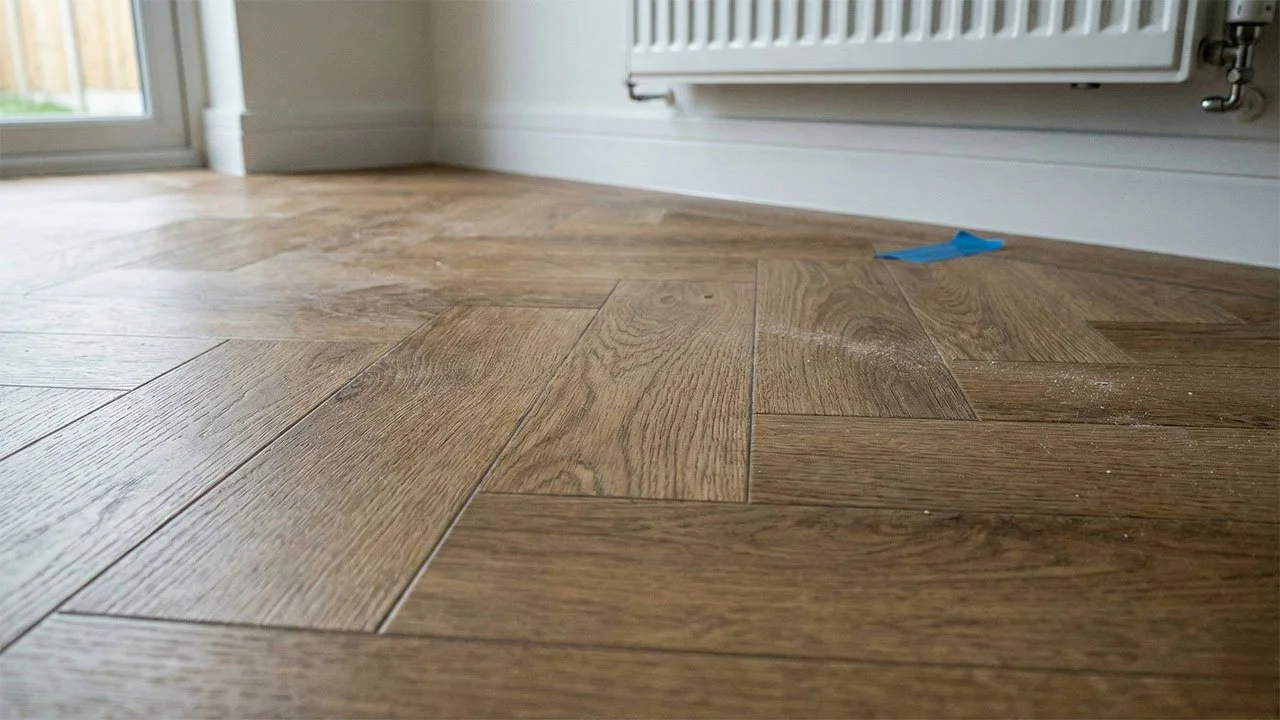
For wood and laminate floors, walk across the surface listening for squeaks or excessive movement. Look along the floor at a low angle to spot any high spots, ridges or undulations. Check that expansion gaps have been left around the perimeter, typically hidden by skirting boards.
In wet areas, check that tiles meet walls properly and that silicone sealant has been applied where necessary. Look for any gaps that could allow water penetration.
Examine the floor levels throughout the property. Significant slopes or dips may indicate problems with the underlying screed or base.
Why Professional Snagging Matters
While this guide provides useful background information, identifying floor finish defects often requires professional knowledge and experience. Our inspectors at Brickkickers use specialist equipment, including thermal imaging as standard, to detect issues that might not be visible to the naked eye.
With the average new home containing over 140 defects according to research, and many of these relating to floor finishes, having a professional snagging inspection gives you the evidence you need to ensure your builder addresses issues under warranty.
Taking Action
If you're purchasing a new build home or have recently moved into one, understanding floor finish standards helps you know what to expect from your builder. The NHBC Standards provide comprehensive guidance on proper installation practices, and builders registered with warranty providers should meet these requirements.
Should you discover floor finish defects in your new home, most warranties allow you to raise these issues with your builder within the first two years. Having a professional snagging report documenting the problems provides valuable support when requesting remedial work.
At Brickkickers, we've been helping new build homeowners identify defects for nearly 20 years. Our nationwide network of experienced construction professionals can inspect your property and provide an independent report detailing any issues found. Whether you arrange an inspection before completion or after you've moved in, we're here to ensure you receive the quality of home you've paid for.
To book a snagging inspection or learn more about our services, contact us on 0845 226 6036 or email info@brickkickers.co.uk.