
Flat roofs, terraces and balconies have become increasingly common features on new build homes. From single-storey extensions and dormer roofs to apartment terraces and projecting balconies on family houses, these elements add valuable amenity space and architectural interest.
Unfortunately, they are also among the most defect-prone parts of any new property, and problems frequently go unnoticed until they become expensive to put right.
If you are about to take ownership of a new home with any of these features, here is what should have been done properly, and what an independent snagging inspection looks for on your behalf.
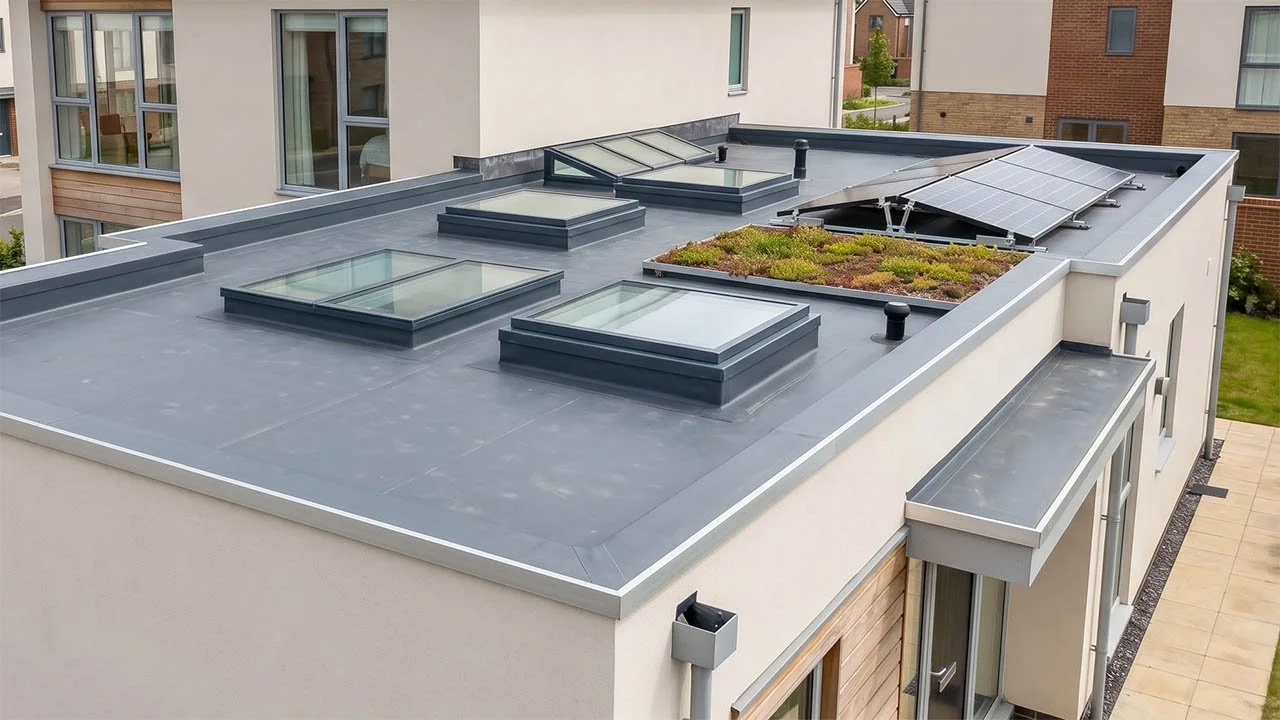
They are not actually flat
Despite the name, a flat roof should never be truly level. To shed rainwater effectively, the finished surface should slope at a minimum of 1:80 towards its drainage outlets, and the original design fall should usually be twice that, around 1:40, to allow for natural deflection in the deck once it carries its full load. Where a roof has been built without sufficient fall, or where deflection has created low spots, you get ponding, which is standing water that sits on the membrane long after rain has stopped.
Ponding is one of the most common defects we find. It accelerates wear on the waterproofing layer, attracts debris that can block outlets, and in cold weather can freeze and damage the membrane. Whether the falls have been formed with tapered insulation, firring pieces on a timber deck or a screed over concrete, the slope towards the outlets needs to be continuous and free from back falls.
Drainage that copes when something goes wrong
Outlets are designed to handle normal rainfall, but they can and do block. For that reason, any flat roof, terrace or balcony enclosed by upstands on all sides should have either two independent outlets feeding separate downpipes, or one outlet plus a clearly visible overflow. The overflow should be sized to handle more than the main outlet, positioned to discharge safely away from the building, and visible when it operates so you know something is wrong.
Outlets on balconies and terraces also need to throw water clear of the building beneath. A poorly designed edge that lets water track back into a soffit, or run down the face of the wall below, will quickly cause staining and, over time, damp problems inside. On stacked balconies, where rainwater cascades from one level to the next, the ground-level drainage at the foot of the building matters just as much, particularly around main entrances and private gardens.
Waterproofing and what sits above it
The waterproofing layer is the part doing the heavy lifting, and it can be a reinforced bitumen membrane, mastic asphalt, a single-ply membrane such as EPDM or TPO, or a liquid-applied system. Whichever has been specified, it should be installed by a contractor approved by the manufacturer, tested for integrity before being covered over, and protected from foot traffic where access is intended.
On accessible terraces and balconies, the membrane should never be walked on directly. Raised paving on adjustable supports or proprietary decking systems is the norm, with the gaps between units sized correctly so rainwater can drain freely, typically 6 to 8mm between units and 10 to 12mm along the perimeter and against any upstands.
Insulation, condensation and the layers you cannot see
Modern flat roofs are generally built as either warm roofs, with insulation directly below the waterproofing, or inverted warm roofs, with insulation above the waterproofing held down by paving or ballast. Both rely on careful detailing to prevent interstitial condensation, which is moisture forming inside the build-up where you cannot see it.
A warm roof depends entirely on the air and vapour control layer (AVCL) below the insulation being continuous and properly sealed at every penetration. Any tear, gap or unsealed pipe collar can let warm, moist air rise into the insulation and condense against the cold underside of the deck. Cold roofs, which place insulation between the joists with a ventilated void above, need genuine cross-ventilation to work, and many fail because the ventilation paths are blocked or were never properly installed.
These are exactly the kinds of hidden problems thermal imaging is designed to reveal. Cold spots in insulation, damp areas in ceilings, and inefficient or missing insulation around openings all show up clearly on an infrared camera long before any visible damage appears. Brickkickers includes thermal imaging in every standard snagging inspection.
Upstands, thresholds and the splash zone
Where a flat roof or terrace meets a wall, the waterproofing should be turned up to form an upstand at least 150mm high above the drainage level. At a door threshold, the rules relax to allow level access: the upstand can be reduced to 75mm, but only if there is a properly designed projecting sill above with a drip at least 30mm clear of the upstand, and a splash zone of at least 150mm above the paving where the wall finish is impervious to water.
Doors and low windows that open straight onto a terrace are one of the most common areas of leakage in new flats and houses. The detailing is fiddly, the tolerances are tight, and shortcuts here lead directly to water inside the building.
Balconies, balustrading and what timber should not be doing
Balconies designed to be walked on should have a service life of at least 60 years. Timber has a limited role in achieving that: it should not be used for posts, columns, gallows brackets, cantilevered joists or guardrail supports. If you see a balcony where the load is being carried by exposed timber elements, that is worth questioning.
Balustrading itself should resist the horizontal loads required by Building Regulations, and should not be fixed straight through a coping or through the waterproofing layer unless very specific detailing has been used, such as a pitch pocket or a raised waterproofed kerb. Fixings driven through copings are a frequent cause of leaks because keeping that junction watertight over many years is extremely difficult.
Copings themselves should project at least 45mm beyond the wall, with a drip at least 30mm clear of the face below, and should be firmly fixed with DPCs and cavity trays linking back to the roof upstand. Missing drips, short overhangs or loose copings let water track back down the face of the building, and the staining that follows is usually the first sign something is wrong.
Why an independent snagging inspection makes the difference
The detailing on flat roofs, terraces and balconies involves dozens of small decisions where the contractor could either follow the design properly or take a shortcut. From outside, much of it is invisible: you cannot see the falls, the upstand heights behind the cladding, the AVCL beneath the insulation, or the condition of the waterproofing under the paving.
Our research has shown that the average new home contains more than 140 defects, and roof, terrace and balcony details consistently feature among the most expensive ones to put right once you have moved in. An independent snagging inspection, ideally before legal completion, gives you a clear, documented record of what needs fixing while the builder is still contractually obliged to deal with it. With thermal imaging included as standard, we can also flag the hidden issues that a visual inspection alone would miss.