
Behind the Plasterboard: NHBC Standards for Internal Walls Explained
When you purchase a new build home, you expect every element of the construction to meet exacting standards. While most buyers focus on the visible finishes, it's the quality of the internal walls that underpins the comfort, safety and longevity of your property. The NHBC Standards Chapter 6.3 provides detailed technical guidance on how internal walls should be constructed, and understanding these requirements can help you identify potential issues that might otherwise go unnoticed.
At Brickkickers, our inspectors routinely examine internal walls as part of our comprehensive snagging inspections. In this article, we'll explain what the NHBC Standards require for internal walls and highlight the common defects we encounter in new build properties across the UK.
The Different Types of Internal Walls
Before delving into the technical requirements, it's worth understanding that not all internal walls serve the same purpose. The NHBC Standards recognise three main categories of internal walls, each with distinct requirements.
Separating walls are those that divide adjoining properties, such as in semi-detached houses or terraced homes. These walls must meet stringent requirements for both fire resistance and sound insulation to ensure your home remains safe and peaceful. Compartment walls serve a similar fire-resisting function within a single dwelling, typically separating an integral garage from the living accommodation.
Partition walls, by contrast, are the internal walls that divide rooms within your home. These may be load-bearing, meaning they help support the weight of floors and roof above, or non load-bearing, where they simply divide spaces without carrying any significant load. The construction requirements differ considerably depending on whether a wall carries loads or simply acts as a divider.
Masonry Internal Walls
Many new build homes feature masonry internal walls constructed from bricks or concrete blocks. The NHBC Standards set out clear requirements for the materials, construction methods and workmanship that builders must follow.
Material Selection
The choice of blocks or bricks for internal walls depends on the height of the wall and the loads it must carry. For homes of one or two storeys, blocks must have a minimum compressive strength of 2.9 N/mm², while bricks require a minimum of 9.0 N/mm². Where the wall forms part of the lowest storey in a three-storey building, or where individual storeys exceed 2.7 metres in height, stronger materials are required, with blocks needing 7.3 N/mm² and bricks requiring 13.0 N/mm².
Mortar and Jointing
The mortar that bonds bricks and blocks together is just as important as the masonry units themselves. According to NHBC guidance, mortar must be mixed correctly and used within two hours unless it's a retarded type. Once mortar has begun to set, it should not be re-tempered by adding water, as this compromises its strength.
Bricks and blocks should be laid on a full bed of mortar, with the vertical joints, known as perpends, solidly filled. Where walls are to receive a wet plaster finish, the mortar joints should be raked out to a shallow depth to provide a key for the plaster. For walls that will be dry lined with plasterboard, the joints should be struck off flush.
Workmanship Standards
The NHBC Standards require internal masonry walls to be accurately set out, reasonably plane and true, and built plumb with level courses. Walls should be constructed in stages or lifts to prevent distortion during construction, as building too much height in a single day can cause the lower courses to deform under the weight before the mortar has fully cured.
Bonding and Tying
Where internal walls meet other walls, they must be properly connected to ensure stability. The NHBC Standards permit two methods for achieving this connection. The first is bonding, where blocks or bricks are interlocked with a tooth pattern at alternate courses. The second is tying, where expanded metal strips or wall ties are installed at a maximum vertical spacing of 300mm.
A particularly important requirement is that different types of masonry should not be mixed within the same wall. For example, using standard concrete blocks alongside lightweight blocks in a single wall can cause cracking due to the different thermal and moisture movement characteristics of the materials. Similarly, using cut pieces of different block types to adjust coursing heights is not acceptable.
Lateral Restraint
Load-bearing masonry walls, including separating walls, must be provided with lateral restraint at each floor level and at ceiling level below the roof. This restraint prevents the wall from buckling outwards and is typically provided by the floor joists themselves if they have a minimum 90mm bearing on the wall.
Where floors do not provide adequate restraint, metal straps must be installed. For timber floors, these restraint straps should have a minimum cross-section of 30mm x 5mm. For concrete floors, straps should be at least 450mm long with the end turned down between joints in the concrete. Restraint straps to separating walls should be provided at maximum 2m centres on each level.
Load-Bearing Timber Internal Walls
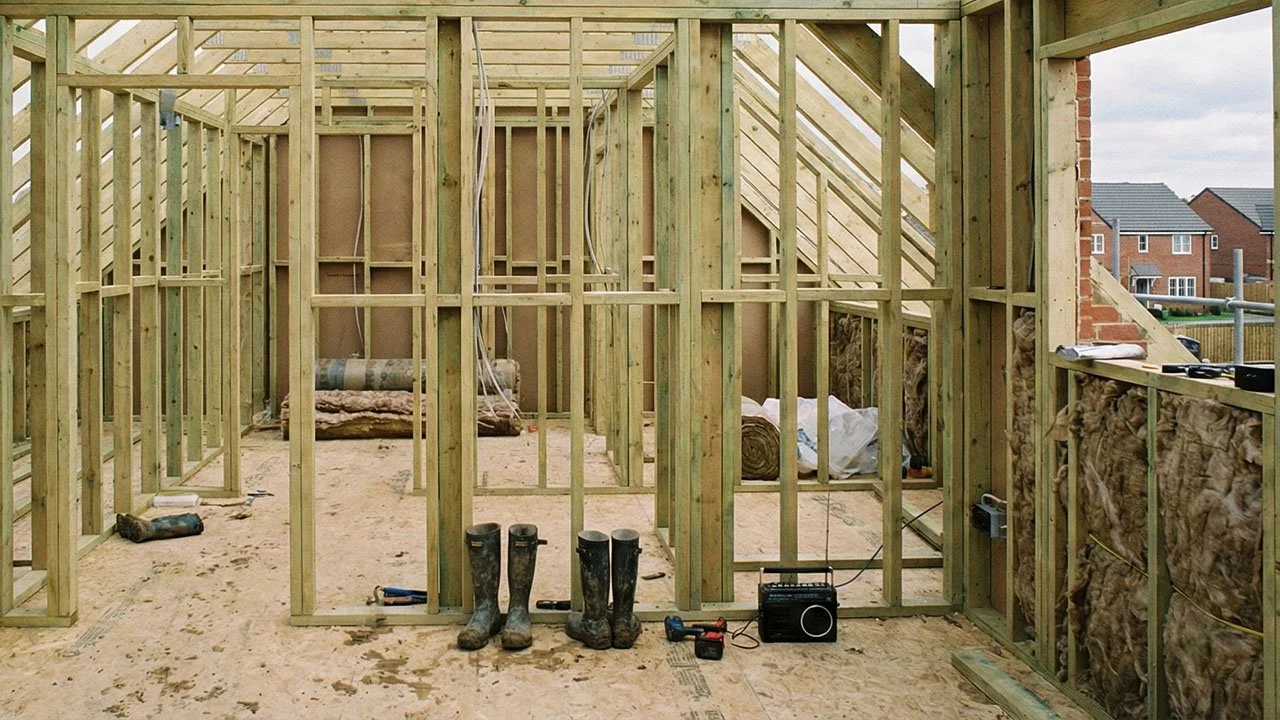
Timber frame construction is increasingly common in new build homes, and the NHBC Standards include specific requirements for load-bearing timber internal walls. These walls typically consist of a framework of vertical studs with horizontal rails at the top and bottom, sheathed with plasterboard or other board materials.
Construction Requirements
The timber used in load-bearing walls must be of an appropriate grade to support the imposed loads, with a maximum moisture content of 20% at the time of dry lining to minimise shrinkage-related problems. Individual studs, rails and head binders should be a minimum of 38mm x 75mm, though larger sizes may be needed to achieve adequate fire resistance.
Studs should be spaced at a maximum of 600mm centres, with mid-height noggings installed where additional stiffness is required. At openings for doors and hatches, lintels and cripple studs should be provided to ensure loads are properly transferred around the opening.
The underside of the lowest sole plate must be positioned at or above the internal finished floor level. This is an important detail that protects the timber from moisture that might otherwise be absorbed from the concrete floor slab below. A damp proof course should also be provided beneath the sole plate.
Framing Joints
All framing joints in timber walls should be secured with a minimum of two nails per joint. Where internal walls are made up from prefabricated panels, continuity must be maintained, typically through the use of a continuous head binder running across the top of the wall.
Fire Resistance Requirements
One of the most critical functions of internal walls is to resist the spread of fire. The NHBC Standards require internal walls to provide fire resistance in accordance with the Building Regulations, with particular attention to walls separating attached or integral garages from the living accommodation.
Cavity Barriers and Fire-Stopping
Where cavities exist within wall construction, cavity barriers must be installed to prevent fire spreading unseen through the building. These barriers should be sized appropriately for the cavity, tightly fitted to rigid construction, mechanically fixed in position and installed in accordance with the manufacturer's recommendations.
At junctions between compartment or separating walls and the roof, special precautions are needed to prevent fire spread. The wall should stop approximately 25mm below the top of the roof framing, with soft fire-stopping material installed above and below the roofing underlay. This gap allows for movement in the roof timbers while maintaining fire compartmentation.
Where services such as pipes, cables and ducting pass through fire-resisting walls, the penetrations must be properly fire-stopped. This fire-stopping should be completed neatly and in accordance with both the Building Regulations and the design information for the specific installation.
Sound Insulation Requirements
For homes that share walls with neighbouring properties, sound insulation is a major concern. The NHBC Standards set out detailed requirements for separating walls to ensure adequate resistance to airborne sound transmission.
Masonry Separating Walls
To maintain sound insulation in masonry separating walls, several factors must be carefully controlled. The correct blocks must be used, with joints, mortar beds and perpends fully filled. Only approved wall ties should be installed, with horizontal spacing of at least 900mm and vertical spacing of at least 450mm to limit sound transmission across the cavity.
Any reduction in the thickness of the masonry should be avoided, and spaces around floor joists where they bear on the wall must be fully filled with masonry and pointed with sealant around the joist. The junction between the separating wall and external cavity walls should be closed with flexible cavity stops.
Even small defects can significantly reduce the effectiveness of a sound-insulating wall. Holes, voids and hairline cracks should be avoided or made good, as these can provide pathways for sound to travel between dwellings.
Chasing for Services
Cutting chases into walls for pipes and cables is one of the most common ways that sound insulation can be compromised. The NHBC Standards place strict limits on the depth and position of chases in sound-resisting walls.
Horizontal chases should not exceed one-sixth of the thickness of a single leaf wall, while vertical chases should not exceed one-third of the thickness. Chases should only be cut where specified in the design, and impact power tools should not be used where there is a risk of damage. Once cut, chases must be fully filled with mortar, and chases on each side of the wall should be staggered to avoid them being back-to-back.
Hollow blocks should generally not be chased unless specifically permitted by the manufacturer, as the thin webs between the voids can be easily broken through, creating a direct sound path.
Rooms Containing a WC
The Building Regulations also require adequate sound reduction between rooms containing a WC and adjacent living rooms, dining rooms, studies and bedrooms, except where the WC is en-suite to a bedroom. The NHBC Standards provide guidance on achieving this through various partition constructions.
For timber studwork, the required sound reduction can be achieved using 75mm studs with either two layers of 12.5mm plasterboard on each side with staggered and filled joints, or one layer of 12.5mm plasterboard on each side with 25mm unfaced mineral wool between the studs. For masonry partitions, blocks with a minimum density of 600kg/m³ finished with plaster or plasterboard on both sides will provide adequate sound insulation.
Non Load-Bearing Partitions
Many internal walls in new build homes are non load-bearing partitions that simply divide spaces. While these walls do not carry loads from above, they still require proper construction to ensure adequate strength and durability.
Acceptable Constructions
The NHBC Standards accept several types of construction for non load-bearing partitions. Masonry partitions remain an option, though they must be properly supported on foundations, concrete floors, or steel or concrete beams, as masonry partitions should not be supported by timber joists or beams.
Timber partitions using 63mm x 38mm studs, rails and head binders are acceptable where the stud spacing is compatible with the plasterboard thickness. Steel partitions using studs and rails from a minimum section of 43mm x 32mm x 0.45mm are also permitted, as are proprietary partition systems that have been assessed in accordance with the NHBC's Technical Requirements.
Walls and partitions should be appropriately supported and should not be supported by a floating floor that incorporates a compressible layer, unless the material is specifically manufactured for that purpose.
Timber Partition Construction
Timber partitions should be placed so that the lowest timber is at or above the internal finished floor level, correctly positioned, square and plumb, with studwork spaced at centres to suit the plasterboard thickness. Extra studs should be provided at openings for doors and access panels.
Partitions must be firmly fixed to each other and to abutting walls, with noggings or extra studs used where necessary. Where partitions run parallel to floor joists or roof trusses, they should be fixed to noggings spanning between the joists rather than being attached directly to a single joist.
An important requirement is that non load-bearing partitions should not be over-wedged against floor joists or roof trusses. Allowance should be made for floors, ceilings and roofs to deflect under load without transferring that load to the partition, which would cause it to become inadvertently load-bearing.
Support for Fittings
Noggings should be provided within partition walls to support fittings such as radiators, wall-mounted boilers, sanitary fittings and kitchen units. These additional timbers ensure that fixings can be made securely into solid material rather than just into plasterboard, which has limited holding strength.
Plasterboard Requirements
The finish applied to internal walls affects both their appearance and their performance. Plasterboard is the most common finishing material, and the NHBC Standards specify requirements for its selection and installation.
Thickness Requirements
The thickness of plasterboard should be appropriate for the stud spacing. For studs at up to 450mm centres, 9.5mm plasterboard is acceptable. Where studs are spaced at up to 600mm centres, 12.5mm or thicker plasterboard should be used.
Tapered edge boards should be used where the plasterboard is to be jointed before decoration, as this allows the joint compound to be applied without creating a raised area that would be visible through the decorative finish.
For fire-resisting and sound-resisting walls, the correct thickness and number of plasterboard layers must be specified in the design information and correctly installed on site. Using the wrong board or omitting layers can compromise both fire safety and acoustic performance.
Damp Proof Courses
Damp proof courses must be installed in internal walls where required to prevent moisture from affecting the building fabric. Load-bearing partition walls built on foundations should have a DPC installed.
Where timber or steel partitions are placed on concrete floors, a DPC should be provided directly below the sole plate or bottom rail, even where there is a damp proof membrane beneath the slab. This belt-and-braces approach ensures that any residual moisture in the concrete does not affect the partition materials.
DPCs should be at least the width of the wall or partition, linked with any adjoining damp proof membrane, and either continuous or lapped by a minimum of 100mm. Acceptable materials include bitumen-based products, polyethylene and various thermoplastics and elastomers conforming to the relevant British Standards.
Why These Standards Matter
Understanding the NHBC Standards for internal walls helps you appreciate the complexity involved in building a new home to acceptable standards. Every wall in your property must be correctly designed, built with appropriate materials, and finished to a standard that ensures long-term performance.
Defects in internal walls can manifest in various ways over time. Poor workmanship in masonry walls may lead to cracking as the building settles and materials move with temperature and humidity changes. Inadequate sound insulation can make life uncomfortable if you share a wall with neighbours. Missing fire-stopping could have serious consequences in the event of a fire.
At Brickkickers, we've been providing professional snagging inspections for nearly 20 years, and internal walls are a focus of every survey we conduct. Our experienced inspectors know what to look for and can identify defects that might otherwise go unnoticed until after you've moved in.
Book Your Snagging Inspection
If you're purchasing a new build home, a professional snagging inspection gives you the information you need to ensure your builder addresses any defects before completion, or to make informed decisions about your purchase. Our comprehensive reports document every issue we find, complete with photographs, and are designed to help you communicate effectively with your builder.
Whether your inspection takes place before legal completion or after you've moved in, Brickkickers can help you achieve the quality of home you've paid for. Contact us today to arrange your inspection and discover the peace of mind that comes from knowing your home has been thoroughly examined by experienced professionals.