
What the NHBC Standards Say About Your New Build Roof
Your roof is arguably the most important element of your new home. It protects everything beneath it from the British weather, contributes to your property's thermal efficiency, and plays a vital role in preventing condensation and damp. Yet despite its importance, the roof is one area that many new build buyers overlook when they move into their property, simply because it seems so far removed from daily life.
The NHBC Standards Chapter 7.2 provides comprehensive guidance on how pitched roofs should be designed, constructed, and finished. Understanding these standards can help you appreciate what your snagging inspector is looking for and why certain defects matter more than others. At Brickkickers, we've been inspecting new build homes since 2004, and roofing issues consistently feature among the defects we identify. This guide will walk you through the key requirements and explain what they mean for you as a homeowner.
What Constitutes a Pitched Roof?
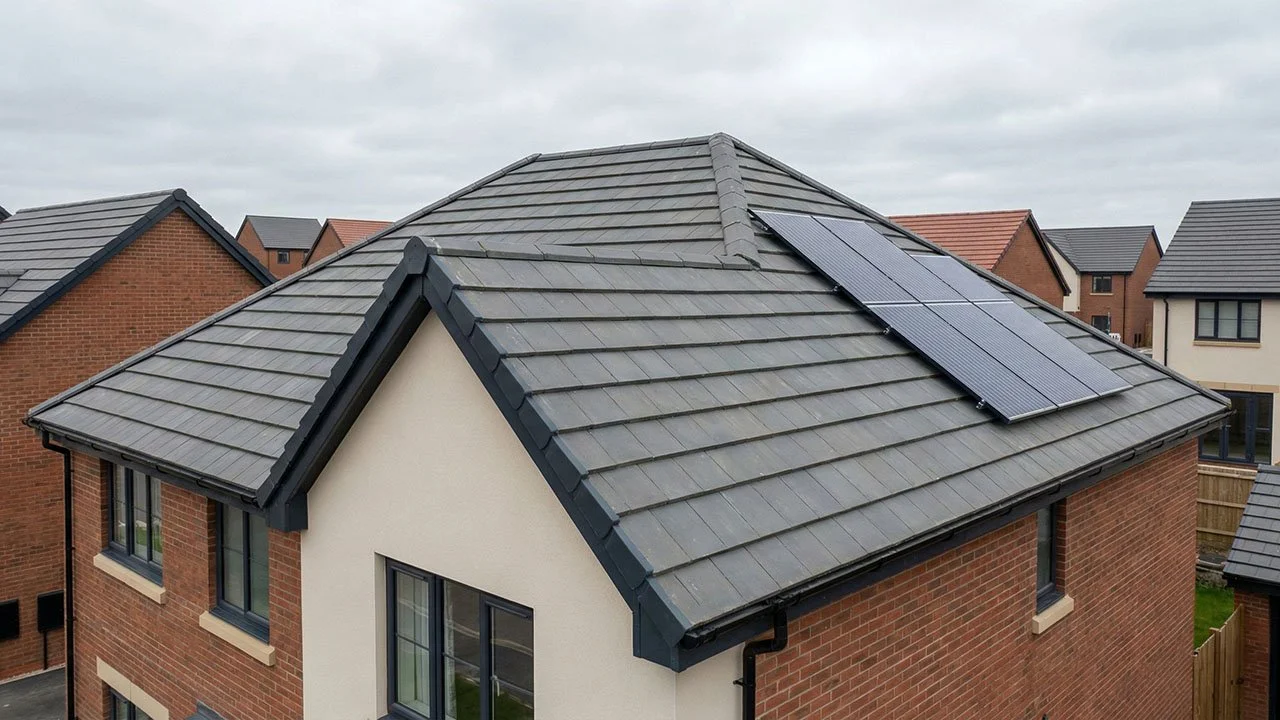
Before delving into the standards themselves, it's worth understanding what we mean by a pitched roof. According to the NHBC definition, a pitched roof is part of the external envelope of a building that sits at an angle between 10 and 70 degrees. This covers the vast majority of residential roofs in the UK, from shallow-pitched designs to steeper traditional styles.
Pitched roofs come in several configurations. A cold roof has insulation laid horizontally at ceiling level, with the space above remaining unconditioned. A warm roof positions insulation along the rafter line, whilst a hybrid roof combines both approaches, with insulation partly on the horizontal ceiling and partly following the rafters. Each configuration has different requirements for ventilation and vapour control, which we'll explore later.
The Importance of Proper Design and Construction
The NHBC Standards make clear that pitched roof designs must account for dead loads, imposed loads, and wind loads. These calculations follow specific British Standards and ensure that roofs can withstand not only the weight of their own materials but also snow accumulation, maintenance access, and the considerable forces that wind can exert on exposed surfaces.
For homebuyers, the practical implication is that roofs should be designed by qualified professionals, particularly where the design involves features like hips, valleys, or spans exceeding 12 metres. Complex roofs or those in exposed locations require engineering input to ensure they perform safely throughout their intended lifespan.
Trussed rafter roofs, which are common in modern construction, must be installed in accordance with the original design. The spacing should not be altered without consent from the designer, and trusses should be evenly distributed at maximum 600mm centres.
Wall Plates and Their Critical Role
Wall plates might seem like a minor component, but they serve an essential function in distributing and transmitting loads from the roof to the supporting walls. The NHBC Standards specify that wall plates should be bedded level, fixed using nails or straps, and extend over at least three joists, rafters, or trusses. They should also be joined using half-lapped joints, including at corners.
Where roofs are subject to wind uplift, which is increasingly common given our changing weather patterns, skew nailing alone may not provide sufficient strength. In these situations, appropriate metal straps should be used. Holding-down straps need to be at least one metre long with a cross-section of 30mm by 2.5mm, spaced at maximum two-metre centres. The fixings must be compatible with the straps and, where they go into masonry, should comprise a minimum of four 50mm long screws into suitable plugs.
Bracing Requirements for Stability
Proper bracing is essential to prevent roof movement and distortion. The NHBC Standards dedicate considerable attention to this topic because inadequate bracing can lead to serious problems including bowing, spreading, and even collapse in extreme cases.
For standard trussed rafter roofs, bracing requirements depend on factors including the roof type, building height, and geographical location. Scotland, Northern Ireland, and the Isle of Man have different wind zones that affect the maximum permissible spans for standard bracing arrangements. Homes in more exposed locations or with larger spans may require bespoke bracing designs.
Roof bracing should be completed before the roof covering is laid. The minimum timber size is 100mm by 25mm, and braces must be nailed twice to each rafter they cross. Where braces are not continuous, they should be lap jointed and nailed to at least two trusses. These might seem like technical details, but they're exactly the kind of requirements that can be overlooked during construction.
Protecting Your Roof from the Elements
Underlay and Sarking
Every tiled and slated roof requires an underlay, which serves multiple functions. It provides a secondary barrier against wind-driven rain that may penetrate through the roof tiles or slates, transports any moisture within the batten cavity into the guttering system, and helps reduce wind uplift acting on the primary roof covering.
The NHBC Standards distinguish between two main types of underlay based on their water vapour resistance. Type HR underlays have high resistance, whilst Type LR underlays have low resistance. The choice between them affects the ventilation strategy required for the roof, which we'll discuss shortly.
Underlay should be laid with a drape between rafters to allow water to drain freely beneath the tiling battens. However, excessive drapes should be avoided as these can transfer loads to the outer covering and cause noise problems during windy conditions. At eaves level, underlay should be supported by a continuous fillet or proprietary eaves support tray to prevent sagging, which could otherwise create water traps.
Battens and Their Fixing
Roofing battens support the tiles or slates and must be adequately sized, spaced, and fixed. According to the standards, battens should be preservative treated and not re-sawn, ripped, or planed after treatment. They need to be at least 1.2 metres long and span a minimum of three rafters.
The fixing of battens is particularly important for resisting wind forces. Nails should have a minimum diameter of 3.35mm and penetrate at least 40mm into the supporting structure. In Scotland and Northern Ireland, ring shank nails are recommended due to the more challenging weather conditions. Battens should be set out so that tiles project a minimum of 50mm over the gutter, ensuring effective water discharge.
Ventilation, Vapour Control, and Insulation
One of the most complex aspects of pitched roof design concerns the management of moisture. Get this wrong, and you risk interstitial condensation, which can lead to timber decay, reduced insulation performance, and ultimately serious damage to your home.
Understanding Condensation Risk
New build homes present a particular challenge because the construction process introduces significant amounts of moisture. Concrete, plaster, and other wet trades all contribute to elevated humidity levels during the first heating season. The NHBC Standards acknowledge this and suggest builders might consider additional precautions beyond the minimum requirements.
The ventilation strategy for any roof depends on several factors: the roof covering type (air permeable or impermeable), the underlay type, whether it's a cold, warm, or hybrid roof, the pitch angle, and the ceiling type. Concrete and clay tiles are typically air permeable, whilst fibre cement slates, sheet metal, and continuous membranes are generally impermeable.
Cold Roof Ventilation
For cold roofs with Type HR underlay and air permeable coverings, the minimum eaves ventilation requirement is 25,000mm² per metre for pitches between 10 and 15 degrees, reducing to 10,000mm² per metre for pitches above 15 degrees. Where the roof pitch exceeds 35 degrees or the span exceeds 10 metres, additional high-level ventilation of 5,000mm² per metre is required.
Type LR underlays allow for reduced ventilation requirements because they permit moisture to pass through more readily. With a normal ceiling (one with typical air permeability), minimum eaves ventilation drops to 7,000mm² per metre. A well-sealed ceiling can reduce this further to 3,000mm² per metre.
Warm and Hybrid Roofs
Warm roofs, where insulation follows the rafter line, require an air and vapour control layer on the warm side of the insulation. This is essential to prevent warm, moist air from the living spaces reaching cold surfaces within the roof construction where it could condense.
For warm roofs with Type HR underlay, minimum eaves ventilation is 25,000mm² per metre, with 5,000mm² per metre at ridge level. A minimum 25mm clear ventilation pathway must be maintained above the insulation.
Hybrid roofs, common in room-in-roof constructions, combine elements of both approaches and require careful detailing to ensure adequate ventilation throughout the different sections.
Vapour Control Layers
Air and vapour control layers should only be installed once framing timbers have a moisture content below 20% and the building is weathertight. They should be placed on the warm side of insulation and fixed at 250mm centres to framing members. Joints should have minimum 100mm laps and be located over rafters.
Where services penetrate the vapour control layer, such as downlighters or pipes, these must be properly sealed. Damaged sections should be made good to maintain the integrity of the barrier. These details are often overlooked during construction but can have significant consequences for the long-term performance of your roof.
Roof Coverings and Their Fixing
The visible roof covering, whether tiles or slates, must be of suitable quality and durability to protect your home from the weather. The NHBC Standards reference numerous British and European Standards for different materials, from clay and concrete tiles to natural slates and metal coverings.
Minimum Pitch and Head-Lap
Different roof coverings have different minimum pitch requirements. Single-lap interlocking tiles typically require a minimum of 30 degrees, whilst double-lap plain tiles need at least 35 degrees. Slates can go down to 20 degrees. Below these angles, there's increased risk of water penetration.
Head-lap, the overlap between courses of tiles or slates, varies according to pitch and site exposure. The minimum for single-lap tiles is 75mm, for plain tiles 65mm, and for slates 54mm. However, these minimums may need to increase in exposed locations or at lower pitches.
Mechanical Fixing
Gone are the days when tiles simply hung on their nibs. Modern standards require mechanical fixing to resist wind uplift. The fixing schedule should be produced by the tile manufacturer in accordance with BS 5534, taking into account the specific site conditions.
Perimeter tiles, those at eaves, verges, ridges, and around roof windows or dormers, should be mechanically fixed using a minimum of two fixings. Slates should be fully nailed across the whole roof area, with centre-nailed slates requiring two nails each.
The fixings themselves must be appropriate for the application. Galvanised steel nails are not acceptable for slates and tiles due to corrosion concerns. Instead, silicon bronze, phosphor bronze, aluminium, or copper nails should be used, with stainless steel acceptable for tiles.
Ridges and Hips
Ridge and hip tiles must be mechanically fixed with self-sealing non-ferrous fixings into timber battens. Where they're wet bedded (set in mortar), a nominal joint thickness of 10mm is specified. The days of relying solely on mortar to hold ridge tiles in place are over, as this approach has proven unreliable in the face of modern wind loading requirements.
Proprietary dry fixed ridge and hip systems offer an alternative to traditional mortar bedding. These should conform to BS 8612 and be installed according to the manufacturer's requirements. They're increasingly common on new builds and generally provide more reliable long-term performance.
Verges
At verges, the junction between the roof covering and the gable end, tiles should be bedded into a 100mm-wide bed of mortar on an undercloak of fibre cement board, plain tile, or slate. Alternatively, proprietary dry verge systems conforming to BS 8612 may be used.
Plain tiles should project 38-50mm beyond the gable wall or bargeboard, whilst interlocking tiles should project 30-60mm. Small sections of cut tile, less than half a tile width, should be avoided. Where unavoidable with interlocking tiles, they should be bonded to the adjacent full tile following manufacturer's recommendations.
Weatherproofing at Critical Junctions
Some of the most challenging areas of any roof are the junctions: where the roof meets walls, where different roof planes intersect, and where pipes or chimneys penetrate the covering. The NHBC Standards provide detailed guidance on how these should be treated.
Abutments
Where a roof meets a wall, flashings, soakers, and gutters should be provided as necessary. Lead flashings require a minimum upstand of 75mm and minimum lap of 100mm. They should be tucked 25mm into a bed joint and wedged in place at no more than 450mm centres.
Stepped flashings, used where a pitched roof meets a wall at an angle, should be cut from a strip at least 150mm wide and be minimum 65mm wide when installed. A preformed stepped cavity tray linked to the flashing prevents water penetrating into the wall construction.
Valleys
Valleys, where two roof slopes meet to form an internal angle, require careful detailing to handle the concentrated water flow. They can be formed using valley tiles, non-ferrous metal, or proprietary systems. Each approach has specific requirements.
Lead-lined valleys should use minimum 1.80mm (Code 4) or 2.24mm (Code 5) lead, supported on exterior grade plywood at least 19mm thick. The lead should be laid in strips no longer than 1.5 metres and lapped by minimum 150mm on pitches above 30 degrees.
Proprietary GRP valley systems offer an alternative that's increasingly popular on new builds. These should be fixed in accordance with manufacturer's recommendations and hold appropriate certification.
Chimneys and Projections
Where chimneys or pipes penetrate the roof, weathertight flashings are essential. Back gutters behind chimneys should have flashings supported by gutter boards to prevent sagging and water accumulation. Cover flashings should overlap the back gutter by at least 100mm.
Pipe penetrations can be addressed using lead slate flashings with upstands or purpose-made accessories. Where lead slates are used, they should be supported, for example with exterior grade plywood, to prevent sagging over time.
Drainage Requirements
The NHBC Standards require drainage for roofs greater than 6m², though consideration should be given to providing drainage for smaller roofs such as dormers and porches. Gutters and downpipes must be sized to accommodate normal rainfall and cope with concentrated flows from features like dormer roofs.
Gutters should be laid with sufficient fall towards outlets unless specifically designed to be flat. Stop ends must be fitted, and the correct fittings used for internal and external angles. Where gutters sit behind parapet walls, overflows should be provided that are visible when operating and positioned to discharge safely away from the building.
Access to Roof Voids
Access to main roof voids should be provided for periodic inspection. Access hatches should not be located directly over stairs and must have a minimum opening of 520mm in each direction. The hatch should either have an air leakage rate not exceeding 1m³/h at 2 Pa pressure, or be a push-up cover weighing at least 5.5kg with proper seals.
Where permanent equipment like water tanks or mechanical ventilation units is installed in the roof void, the design should allow reasonable access for servicing, maintenance, and removal. This may require permanent platforms and boarded walkways between the access hatch and equipment locations.
What This Means for Your Snagging Inspection
Understanding these standards helps explain why a professional snagging inspection is so valuable. When our inspectors examine a new build roof, we're checking compliance with these detailed requirements, many of which aren't visible once the home is complete but have lasting implications for performance and durability.
We look for evidence that trusses are properly braced and fixed to wall plates. We check that ventilation provisions are adequate and that insulation has been correctly installed without blocking airways. We examine tile fixing, particularly at perimeters where wind uplift is greatest. We assess flashings, valleys, and other weathering details for proper installation. And we verify that access provisions meet requirements.
Our data shows that the average new home has in excess of 140 defects. Roofing issues may not always top the list numerically, but their potential consequences make them among the most important to identify and rectify promptly. A missing tile clip might seem trivial, but it could lead to tile displacement in high winds. Inadequate ventilation might not cause visible problems for years, but by then you could be facing expensive remedial work for timber decay.
Commissioning Your Snagging Inspection
The ideal time for a snagging inspection is before you complete the purchase, during the period when your builder invites you to identify issues for rectification. This is typically 10 to 14 days before legal completion. Having a professional inspection at this stage gives you the strongest position to ensure defects are addressed.
However, if you've already moved in, it's not too late. Standard snagging inspections can identify issues within the first two years while they're still covered under most warranty provisions. For homes with ongoing problems or disputes with builders, customised inspections can provide the detailed evidence needed for resolution.
At Brickkickers, our nationwide network of experienced construction professionals has been helping homeowners get the quality they've paid for since 2004. Our independent reports are compiled against all major warranty providers including NHBC, LABC, Premier, and others. We include thermal imaging as standard, helping detect issues like insulation gaps and heating system problems that might otherwise go unnoticed.
Your new build home represents a significant investment, and its roof is fundamental to protecting that investment. The NHBC Standards for pitched roofs are comprehensive for good reason: getting roofing right matters enormously for the long-term performance, comfort, and value of your home.
While you don't need to become an expert in roof construction, understanding these standards helps you appreciate what proper quality looks like and why professional snagging inspections are so valuable. Whether you're buying a new build or have recently moved in, ensuring your roof has been correctly constructed is one of the most important checks you can make.
If you'd like to discuss a snagging inspection for your new build home, contact Brickkickers today. With nearly 20 years of experience and inspectors who understand all elements of new home construction, we're here to help you get the quality of home you've paid for.
Brickkickers provides professional snagging inspection services across the UK. To learn more about our services click here or call 0845 226 6036.