
Solar Panels on New Build Homes: What Every Buyer Needs to Know
More and more new build homes across England and Wales are being fitted with solar panels, and within the next couple of years, they'll be required on almost every new property.
That sounds like great news for buyers, and in many ways it is. But there's a growing gap between what homeowners expect from their solar installation and what developers are actually delivering.
If you're buying a new build, or thinking about it, understanding how solar panels work, what the regulations require, and where developers tend to cut corners could save you thousands of pounds and a great deal of frustration down the line.
How Solar Panels Work (and Why They Matter)
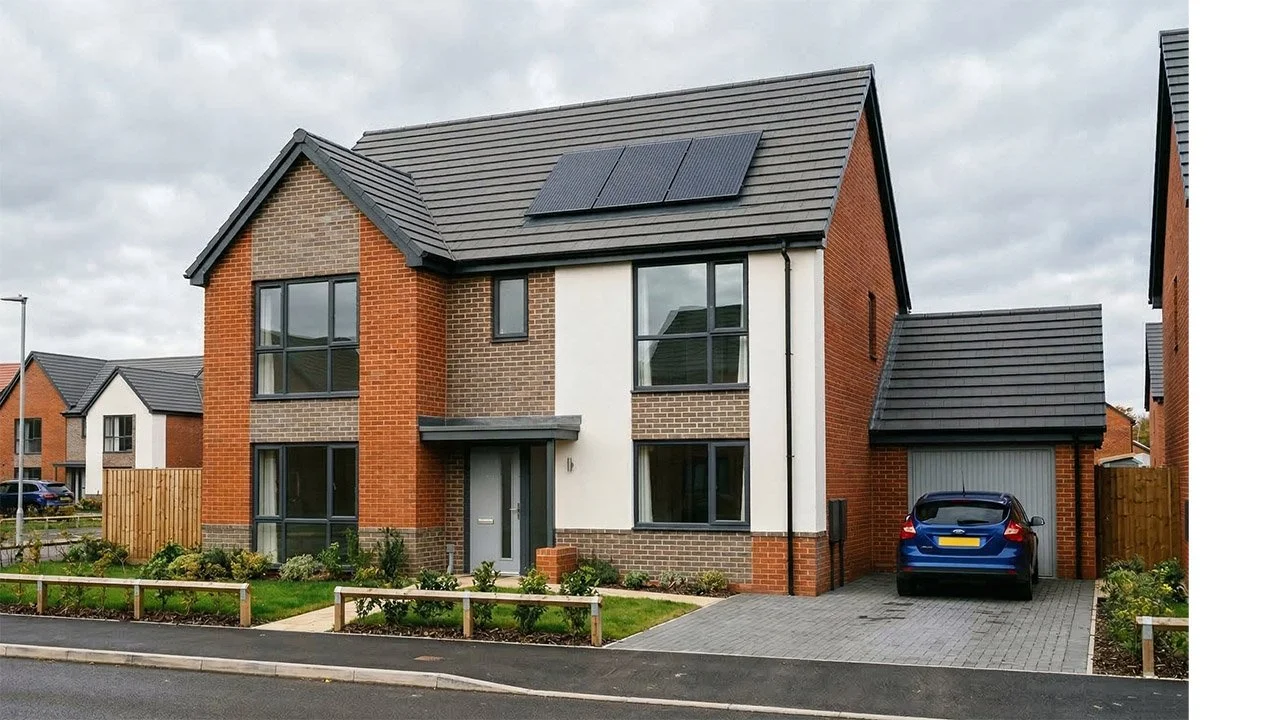
Solar photovoltaic (PV) panels convert daylight into electricity. Contrary to popular belief, they don't need blazing sunshine to work. The UK's climate is perfectly adequate for solar generation, and a well-sized system on a typical family home can generate a significant proportion of the household's annual electricity needs.
The financial case is straightforward. Electricity generated by your panels is free to use, and any surplus can be sold back to the grid through the Smart Export Guarantee (SEG), earning you a small income on top of your savings. A properly designed solar system with battery storage can dramatically reduce your reliance on grid electricity, insulating you from future energy price rises.
Beyond the household finances, solar panels reduce carbon emissions. The Energy Saving Trust estimates that a typical UK home with solar PV can cut its carbon output by around a tonne per year. With the government's net zero targets driving policy across the construction industry, solar is no longer a nice-to-have; it's becoming the standard.
The Regulatory Landscape: What's Changing?
The regulatory picture is shifting rapidly, and it's worth understanding where things stand and where they're heading.
Since the 2022 update to Part L of the Building Regulations, new homes in England have been required to achieve a 31% reduction in carbon emissions compared with the previous standard. While solar panels aren't yet explicitly mandated in England, they've become the most common and cost-effective way for developers to hit the required energy efficiency targets. By the end of 2024, around 42% of new homes in England were being built with solar panels, a dramatic increase from just 13% in the same period of 2023.
That figure is set to climb much further. In June 2025, the government announced that under the forthcoming Future Homes Standard, solar panels will be required on the vast majority of new homes. The final specifications make clear that panels must be installed on all suitable roof space, with "solar-ready" pre-wiring only acceptable in rare cases involving heavy shading or heritage restrictions. The Future Homes Standard is expected to become law by the end of 2026, with a transition period running into 2027.
Wales is moving even faster. An amendment to Part L of the Building Regulations will make solar panels a functional requirement for all new homes in Wales from 4 March 2027, making it the first part of the UK to introduce such a mandate.
Scotland, by contrast, has taken a different approach. While Scottish building standards are stringent on energy efficiency and have banned gas and oil boilers in new builds since April 2024, there is currently no legal requirement for developers to fit solar panels. If you're buying a new build in Scotland, don't assume solar is included; ask the developer directly.
The broader direction of travel is unmistakable. The Future Homes Standard aims to ensure new homes produce 75–80% less carbon than those built under the 2013 regulations. Solar PV is central to achieving that goal.
The Problem: Developers Are Fitting the Bare Minimum
Here's where things get frustrating for homeowners. While more new builds are being fitted with solar panels, many developers are installing the absolute minimum number of panels needed to pass their energy efficiency calculations, not the number that would actually benefit the homeowner.
Under the current system, a home's energy performance is assessed using the Standard Assessment Procedure (SAP). SAP calculations award a relatively modest number of points for solar panels, which means developers can satisfy the requirements with a surprisingly small system. A 2.5kWp installation (typically four to six panels) is often enough to tick the box, even though a system of that size will generate only a fraction of what a typical household consumes.
The result is that buyers move into their new home expecting meaningful energy savings, only to discover that their handful of panels barely makes a dent in their electricity bills. The panels are there to pass a regulatory test, not to serve the homeowner.
Adding more panels after the fact is far from straightforward. It typically involves hiring scaffolding, applying to your local Distribution Network Operator (DNO) for permission to connect additional generation capacity, potentially upgrading your inverter, and paying installation costs that are considerably higher than they would have been if the panels had simply been fitted during construction. What might have cost the developer a few hundred pounds extra during the build phase can easily cost the homeowner several thousand pounds to retrofit.
The forthcoming Home Energy Model (HEM), which will replace SAP under the Future Homes Standard, is expected to assess energy performance more accurately and should, in principle, encourage larger systems. But until that transition is complete, many buyers will continue to receive installations designed to meet a minimum threshold rather than maximise benefit.
The Cheap Inverter Trap
If the number of panels is the first problem, the quality of the inverter is the second, and it's one that most buyers don't discover until it's too late.
The inverter is the piece of equipment that converts the direct current (DC) electricity produced by your panels into the alternating current (AC) your home uses. It's a critical component, and the type of inverter your developer installs has major implications for what you can do with your solar system in the future.
There are broadly two types to be aware of. A standard string inverter does the basic job of conversion but typically has no provision for connecting a battery. A hybrid inverter, on the other hand, is designed to work with battery storage systems and allows you to store surplus solar energy for use in the evening or during power cuts.
Most developers, focused on keeping costs down, are fitting basic string inverters. This works fine on day one, but the moment you decide you'd like to add a battery, perhaps because you've realised you're exporting electricity to the grid during the day at a few pence per kilowatt-hour and then buying it back in the evening at 25p or more, you run into a wall.
Retrofitting battery storage to a system with a basic string inverter can be complex and expensive. It may involve replacing the inverter entirely with a hybrid model, modifying your home's consumer unit and wiring, and potentially re-certifying the installation. A hybrid inverter upgrade alone can cost between £1,200 and £2,000 on top of the cost of the battery itself. You could end up spending £5,000 to £8,000 or more on an upgrade that would have added only a modest amount to the build cost had it been specified from the outset.
The inverter also has a significantly shorter lifespan than the panels themselves. Solar panels typically last 25 years or more, but inverters often need replacing after 10 to 15 years. If a cheap, basic inverter fails and you're replacing it anyway, that's an opportunity to upgrade to a hybrid model, but it's still an unnecessary expense if the right inverter could have been fitted from the start.
Talk to Your Developer Before Building Starts
The single most important piece of advice for any new build buyer is this: engage with your developer about the solar installation as early as possible, ideally before construction begins.
Once a house is designed and the roof is going on, making changes becomes progressively more difficult and expensive. But during the design and early construction phases, there's a window of opportunity to influence what goes onto your roof and into your electrical system.
Here's what to push for. First, maximise the number of panels. Ask for panels on all suitable roof space, not just the minimum needed for regulatory compliance. The incremental cost of additional panels during the build is relatively small, and the long-term savings are significant. Second, specify a hybrid inverter. Insist that the inverter installed is capable of supporting battery storage, even if you don't plan to add a battery immediately. This keeps your options open and avoids the costly retrofit trap described above. Third, consider including a battery from the outset. If you can stretch your budget, having battery storage installed during the build phase is considerably cheaper and simpler than adding it later. The wiring, mounting, and integration can all be done as part of the initial electrical fit-out, and you'll start benefiting from stored energy from the day you move in. Finally, ask about the specific equipment being used. Request the make and model of the panels and inverter, and check whether the inverter is compatible with the leading battery systems on the market. Don't accept vague assurances; get the specifications in writing.
Some developers will be receptive to these requests, particularly if you raise them early. Others may push back or charge a premium for upgrades. Either way, knowing what's being installed and having the conversation before contracts are signed puts you in a far stronger position than discovering the limitations after you've moved in.
Roof Orientation and Panel Placement
It's also worth asking your developer about where the panels are being positioned and why. Developers often default to whichever roof face is most convenient or cost-effective to install on, which isn't necessarily the orientation that will generate the most electricity for your household.
South-facing roofs receive the most total sunlight over the course of a day, making them the traditional choice for solar installations. However, an east-west split, with panels on both the morning and afternoon roof faces, can actually be better for self-consumption. This arrangement generates electricity more evenly across the day rather than producing a large peak around midday when you may not be home to use it. It's particularly effective if you don't have a battery, as more of the generation aligns with typical household usage patterns.
Shading is another factor. Trees, neighbouring buildings, chimneys, and even satellite dishes can significantly reduce panel output. Your developer should be able to provide a shading analysis as part of the design process. If they can't, or won't, that's a red flag.
Making the Most of Your Solar System
Once you're in your new home with a solar installation, there are some practical steps you can take to maximise the benefit.
Understanding when your panels generate the most electricity and adjusting your usage patterns accordingly can make a significant difference. Running high-consumption appliances like washing machines, dishwashers, and tumble dryers during daylight hours, when your panels are generating, means you're using free electricity rather than drawing from the grid.
If you have battery storage, or plan to add it, look into time-of-use tariffs. Providers like Octopus Energy offer tariffs where the price of electricity varies throughout the day. With a battery, you can charge from the grid during cheap overnight periods and use that stored energy during expensive peak hours, on top of whatever your panels generate during the day. The savings from combining solar panels, a battery, and an intelligent tariff can be substantial.
Don't forget the Smart Export Guarantee, either. If your system is MCS-certified (which it should be), you're entitled to receive payment for any surplus electricity you export to the grid. The rates vary between providers, so it's worth shopping around.
Your Pre-Completion Solar Checklist
Before you complete on your new build, make sure you've covered the following. Ask for the MCS certificate for the solar installation, confirming it's been installed to the required standard. Check the panel specification, including the make, model, and total wattage of the system. Confirm the inverter model and verify whether it's compatible with battery storage. Request the DNO connection paperwork confirming the installation has been notified to the local distribution network. Ensure you receive full handover documentation, including operating instructions, warranty details, and maintenance guidance. Ask whether a generation meter has been fitted, which you'll need for Smart Export Guarantee payments.
Solar panels on new builds are a genuinely positive development. They reduce energy costs, cut carbon emissions, and add value to your home. But the way developers are currently installing them, often with the minimum number of panels and the cheapest possible equipment, means many buyers aren't getting the full benefit.
By understanding the regulations, asking the right questions, and engaging with your developer early, you can ensure that your new home's solar installation is designed to work for you, not just to pass a compliance test.